Film Opening

Showing posts with label Louis Caldwell Evaluation. Show all posts

Monday, 24 March 2014

Q1. In what ways does your media product use, develop or challenge forms and conventions of real media products? - Louis Caldwell


In order to create and present a British Independent Drama, starring a teenage cast, we researched film and Television of a similar style and audience in order to find influence for our film opening- in particular British productions. Through using, developing and challenging conventions, we were able to create a similar opening.

Our Film- Growing Pains:

Our film follows two characters- Clem, a middle class white 17 year old male, and Melissa, a 17 year old girl- in London, as they go bout their lives, growing up in a culturally diverse city. Through a chance meeting at a London bus stop, the two characters fall deeply in love. After spending time together and getting to know one another, the pain are separated by Melissa's gang member brothers, who threaten Clem. However, one evening Clem saves the life of one of the brother after he is stabbed, the family gain respect for him and the lovers are reunited.

Our film is appropriately structured as an independently produced film, as support from a large production company is highly unlikely for first time independent film producers.

Within our opening, we included video footage, sound, music and titles- they components of any film opening, following a chronological sequence, it will use cross-cutting to present the lives of the 2 protagonists

As a typical Film narrative Structure, we followed  Todorov's Narrative Theory:


Another structural theory we used was Roland Barthes' Theory of codes:

Action Codes - The mixture of action shots of Clem riding his skateboard- switching between GoPro and Master camera view- causing the audience to be gripped and drawn into the narrative

Enigma Codes-Where is Clem skating to? Why is there nothing for Melissa to do? Why do Melissa and Clem make awkward eye contact?

Semantic Codes- The awkward looks exchanged by and Melissa when seated next to one another suggest that they have feelings for each other

Symbolic Codes- Clem is a white middle class teen with the stereotypical background- he dresses with style and lives in a wealthy area. In contrast with this is Melissa, who represents the working class ad lives on an estate- they each represent the two classes and their relationship alludes to the future conflict

Referential codes- Shani's Hoop earrings reference the working class and unemployed females in particular, furthermore, her prop, a carton of KA has links to the Afro/Caribbean community


Genre: British Drama


The films above are all famous examples of British Drama films, however, as shown, it is rare that they are independently produced.

We decided that our genre should be more specific- focusing on the more niche Urban Drama genre

Examples of this are:

Attack the Block- We developed the convention of having transiprt and chase scenes in order create action- replacing the cycling gang members with a middle class white boy  to highlight how out of place he is, whereas within attack the block, the characters use their bmx bikes as a way of escaping the aliens, creating many fast paced chase scenes.


Kidulthood- From this we took inspiration for the behaviour of the Black british- We used  this convention to build Mellisa's character and her family's attitudes- in particular the roles of her brothers are based on the gang members. Also, we used this film to base the dialogue and slang of our film on.


Fishtank- This is where we took inspiration for the working class female character of Melissa, in particular the problems she faces in life as she grows up. By developing the convention of a struggling female protagonist and highlighting the problems of racial ignorance and its effect on her.


One convention of the genre is that it carries particular themes, these are present throughout most urban productions:

-Love
-Disaster
-Conflict
-Friendships
-Relationships
-Growing up

We effectively managed to base our film around these themes, using this convention to create an obviously urban atmosphere for the opening, yet also contrasted it by sowing the journey of Clem through his Middle Class neighbourhood.

Style

One of the key conventions of a British Indie Drama is the setting- an obvious or relatable location- most likely a council estate within the city (often London). For our film, we decided that an urban setting was most appropriate, and specifically chose our location based upon the fictional estate 'Summerhouse' in the British TV Drama Top Boy.


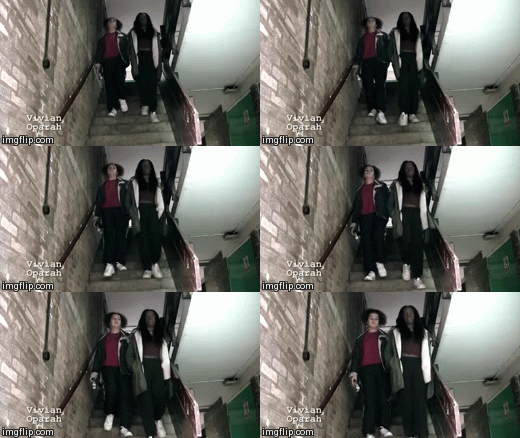
We took the stereotypical estate- Gloomy stairwells and dirty hallways, however we replaced the stereotypical male gang members with the two females. By presenting the presence of females within this environment, we developed the convention of an stereotypical estate.


Titles

-Somers Town:

When designing our titles, we used the British indie drama Somers Town as an influence. The titles within Somers town are minimalistic- a pain white font in small text usually in the bottom left or right corners in the shot so as to keep the focus on the urban city theme.

We conformed to this convention by creating similar small titles to highlight the setting and character types to the audience, yet retain the gritty theme central to its narrative.


Romance

We also challenged the conventions of a stereotypical romance film. By including the theme of forbidden love, our film bases its romantic nature on a Romeo and Juliet-styled relationship, with the lovers torn apart by those around them. However, by including a Black female within the narrative, we have challenged the expectation of two white lovers, with the urban twist providing more of an appeal to our target audience.


The meeting of  Clem and Melissa
romeo juliet meeting
The meeting  of Romeo and Juliet in Romeo and Juliet(1996)

Style

We designed our film specifically so that it recreated a realistic representation of modern London- highlighting both the positives and negatives of inner city British life. We purposefully chose to grade our film so that it appeared dark and miserable- similar to the mood in Misfits- a comedy TV drama about a group of friends doing their community service in the city. We also a similar pace to misfits- cutting between fast action shots eg. the skateboard, and slower shots of dialogue being exchanged-to give a professional, believable look. By using these conventions, we successfully gave our fiml the desired look, using the professional style of editing to make our own film look as realistic as misfits.

Dark grading and mood in Misfits
Dark grading and mood in our film
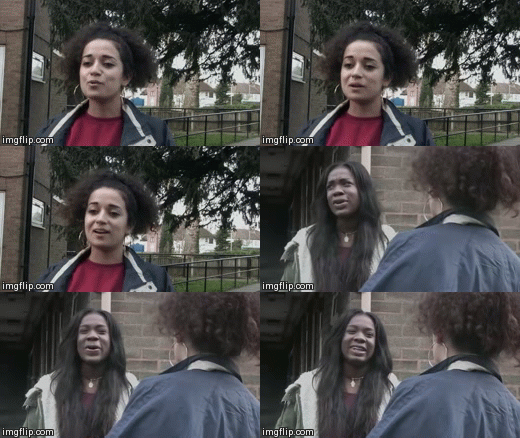
We also used continuous, tight framing, and close ups of Melissa's conversation in order to create a real-time sequence- our carefully edited production displays high level editing similar to that in Fish Tank, a British Urban Drama focusing on a female lead in particular. The film, like ours, uses close ups and match constant shot reverse shot and match on action to effectively present the urban environment from Mia, the female lead's perspective:

Close ups and shot-reverse-shots in our film


Close ups and shot-reverse-shots in Fishtank

Through using this conventional style of editing, we were able to present our working class characters realistically, just as they are in Fishtank- reflecting their attitudes and behaviour with one another through the use of shot reverse shots and close-ups.

Overall, during the production of our film opening, we used many conventions from other media products, specifically films and TV shows, in order to ensure that our own product was believable, understandable and engaging. Furthermore, we also occasionally developed these conventions in order to employ our own message- specifically regarding racial attitudes within society, and challenging other conventions to give a modern, more realistic portrayal of inner-city life.


Sunday, 23 March 2014

Q2 How does your media product represent particular social groups?

As our film focuses upon an inner-city romance torn apart by racial conflict within society, the primary focus of our film is ethnicity- presenting and highlighting the differences between a white middle class male and a  black working class teenager. Furthermore our film represents British teenagers, in particular those from London, and the difficulties in today's society.

The following Mind Map highlights our four key representation areas:

Race, Nationality, class and Age


Our main male protagonist is Clem:


Our  female protagonist is Melissa:


Representation in Clothing


Clem


Clem, a 17 year old middle class British white teenage boy


-Branded clothing- shows fashion consciousness, however no very obvious
-Middle class background highlighted by his stylish outfit- cool character to look up to
-Skate brands to allude to his passion of skateboarding- appeal to indie teens
-Accessory- skateboard- suggest his motive within the opening- appeal to action sport lovers


Melissa


Typical 17 year old girl :
-Own personal style, however some common items such as white Nike trainers- appeal to working class females 
-Quite urban/ relaxed- simlar to character Shaks in Sket(2011)
-Accessory- iPhone- represents socially active and technology dependent generation- uses it for social reasons not for business.


Language

When constructing the conversation, we felt that it wass appropriate to integrate british slang, and 'London' phrases into it in order to reflect the urban, teenage, attitudes of the girls and how they are not quite adults- still with simple thoughts and speech.

This sample of our script highlights this:

Slang provides a modern and relevant urban twist within the film, and makes it more attractive and relatable to those from an urban, working class background, or others who enjoy urban themed films.

An example of the use of slang within British Indie drama is in the film Kidulthood, this scene higlights the successful integration of british slang:


SETTING

Another way in which we represented particular social groups was the presentation of setting- by situating our opening in suburban London, our audience could pick up on identifiable buildings and landscapes.

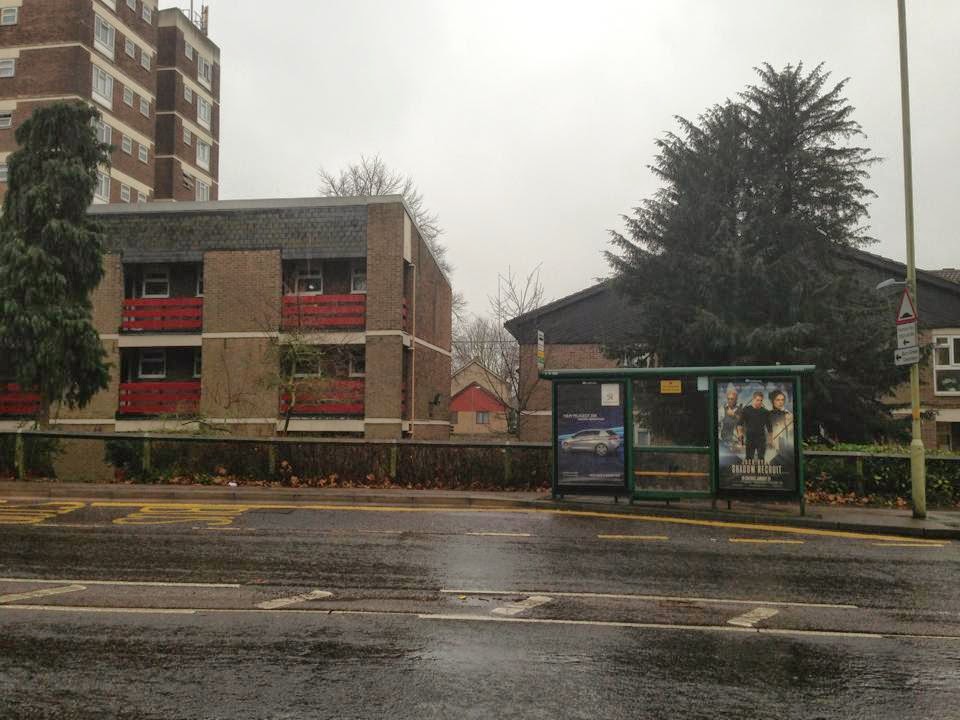
In  particular, we made use of the iconic london bus stops, both representing those familiar with london's public transport, and also those who are viewng to dicover an inside perspective of the city.


Photograph showing how to navigate step 1  of this route, click to enlarge photo
-Compared with a central London bus stop, ours was vandalized and dirty, increasing its reality

Equally, we also focused on representing the middle classes, using Clem's journey through the town to show this- larger white detached houses and longer thinner streets presented a more upper class, respectable neighbourhood.


We also deliberately presented and brought together two completely different character types- black and white- in order to

a) Present a story of how two binary opposites break many conventional views and stereotypes when they become attracted to one another- attracting multiple cultures towards the film.

b) Present the awkward/ difficult situations that love and romance cause, making it relatable to most teenagers.

This carries the message that the divisions and separation within British society, especially in culturally diverse areas such as London- the whole point of our film.


Friday, 21 March 2014

Q3 What kind of media institution might distribute your media product and why?

As our intention was to produce a film that would change the perspective of British society regarding racism, our film would more than likely be suited to commissioning from film 4 under their community-changing independent film funding scheme- this would cover the expenses of producing the film.


Specific examples of film 4 commissioned films Taken from FILM 4 Commissioning FAQ's

This Information presented on channel 4's website helped me to see what type of films gain commissioning.
We decided that commissioning our film via FILM4 would help boost its box office success as well as a definite Television release later on, most likely on the mainstream channel Channel 4, gaining more publicity and audience for our film. The institution have a high success rate of taking indie films and turning them into to worldwide successes- for example films such as Slumdog Millionaire and The King's Speech.

Production Company

We decided to create an appropriate British production company called Pigeon Productions -a low budget production Company producing British Indie Dramas, and challenging films.

This is the opening title for Pigeon Productions which we produced- the clip reflects on the urban British nature best symbolised through a pigeon.

We decided that when distributing the film , the most suitable institution would be The Works UK, which specialises in distributing independent films, with particular success within the urban drama Genre- successfully distributing Wild Bill (2012) into national success. Although we do not intend to release our film in high street cinemas, The Woks will ensure that the screenings are well publicised and gain large audiences.


Furthermore, the chart on the left shows how even the indie film market in the UK is dominated by larger production companies such as StudioCanal and 20th century Fox, therefore we knew that box office success was very unlikely, focusing on screening our film in indie cinemas across the UK, predominantly in London where we can attract our core target audience.


We soon discovered the Picturehouse independent film cinemas, which have many screens across the country, especially in London, here are the main cinemas where we would screen our film:


We would most likely only release the film in these screens for a limited amount of time- for around 2 weeks, as this would both encourage the audience to go and view the film whilst they can, and also limits the chances of losing money if the screenings are unpopular. We would release the film in summer time, when the target audience are less likely to be engrossed in work or studies and therefore are more flexible as to when they can visit the cinemas.

Similar Film - Somers Town

Somers town is a 2008 British Independent Drama set on an estate in inner London.

File:Somers town british quad.jpgThis film carries a similar theme to our film as it presents an unexpected relationship between two completely different types of people- two teenage boys- Marek, a Polish immigrant, and Tomo, a British teen.

Somers town was directed by award winning British director, and produced by Big Arty Productions which he part-owns.

The film was low budget, shot on low quality cameras, and was completely funded by train company Eurostar, and was distributed by the Works(UK) making £566,616 in the box office.

Learning of the success of this film, we decided that funding was the most successful way to produce our film, although we would not take the mainstream cinema release approach like Somers Town did.

Thursday, 20 March 2014

Q4 Who would be the audience for your media product?

As an urban drama, the primary audience for our film are 16-24 year old Brits, who can identify both the setting and also the character types within the film, the are fans of similar TV Dramas and British Indepepndednt mofilms, and as teenagers they like to be shown drama and controversy. They are also the most likely to understnd and relte to the slang and urban settings within the film.

Primary Audience:  


Secondary Audience: 
Audience Profile:

Age: 24-35

Interests: As Adults, this audience are interested in building up their own lives- a house/ family, and are settled into their working life. They will watch the fi

Media Usage: This audience will most likely use the film as a way of exploring the city and the urban culture, also using it as entertainment and escape.

Media Viewing: Most Likely to view the film on the internet/ stream via their phone/ tablet

Interested in films such as: Fishtank(2009), Sket(2011) 


Tertiary Audience: 
Audience Profile:

Age: 36+

Interests: Sports, spending time in their city(London), watching relevant TV dramas and urban films, also like spending time with girls/ other men.

Media Usage:  As adults, the audience will use the film as a way of remembering their own childhoods, perhaps they grew up in a similar inner-city environment- this provides nostalgia for them

Media Viewing: Most Likely to view the in the cinema with their partner/ friends- least likely group to pirate/ illegally stream our film.

Lorraine Burroughs and Ashley Walters in Top Boy
Dushane and Rihanna from Channel 4's Top Boy
Interested in films such as: 

Top Boy (TV Drama) - related themes or urban setting, black and white characters, conflict and love.

Specifically, in series 2 episode 4, we are presented with unexpected love between black gangster Dushane and middle class solicitor Rihanna- similar to unconventional relationship presented within our opening


Wednesday, 19 March 2014

Q5 How did you attract/address your audience?

There are many ways in which we have attracted and addressed our audience:

Casting
- By specifically selecting a diversity of actors from different racial and cultural backgrounds, we were able to create a microcosm of society in London today.

-We specifically selected actors from our local neigbourhoods in order to give a stereotypical representation of both Age, Gender, Ethnicity and Class.

- In the complete product, the audience may find pleasure by seeing themselves within the film, especially those from a less commonly presented ethnicity within the romance genre such as British Africans.

- This further created a multicultural London-breaking barriers that previous films hadn't passed when presenting the diversity within the city.

Characters

- Our characters also helped us to appeal to the audience by presenting a variety of character types

- The mix of backgrounds and views of society helped to appeal to a larger variety of people.
- With a female protagonist, our film also attracted females, who could relate to Melissa's character and the situations she is put in, as well as using her as an escape from their own lives.
-Similarly, males could relate to Clem's character,  as an adventurous teenager, he creates both excitement for those who can relate to him, and is also appealing to girls who enjoy the male heroes in films.


Setting

- One of our key strengths was certainly our use of recognisable London locations

-These enabled us to successfully suspend the disbelief of the audience and present a situation which they, especially a local audience, could relate to.

- This also highlights how we confrmed to expectations- specifically choosing a familiar estate backdrop in order to signpost the genre and themes of the film to the viewers.

Narrative
- By including surprising twists and enigma codes in our opening, we successfully alluded to the theme of love, and as the film progresses, its dangers

-The use of slang also effectively addressed the British youth, creating a realistic image of their everyday lives
slang phones hugs

- The primary teen audience could further relate to our presentation of the awkwardness of love, and the relevant themes of relationships and burning desire.

Furthermore, by applying the uses and gratifications theory, our film addressed the audience in the following ways:


In order to assess whether targeting our audience had been successful, I created a survey on www.surveymonkey.com in order to gain feedback on the film, its viewers, their film preferences and demographics:

This screenshot shows that the majority of the viewers of our opening were male- twice as many as females.

                                      This survey result shows that our actual genre- British urban drama, wasn't fully recognized, therefore it suggests that the genre isn't clear enough within the opening.

However, this result suggests that our trailer did attract the audience- by drawing them in using the action and narrative, they were made to want to continue watching.


Overall, the results from my survey both conclude that we successfully targeted and attracted our target audience with our product, and that overall, the opening was successful at fulfilling its purpose.


In order to assess how we appealed to the audience on a more personal scale, I used review sessions with members of our core target audience to assess their personal view of the opening:

Female,17

What did you like about the opening?
I liked the structure of the opening and the way that the story unfolds through the two paths as the characters meet for the first time, and the emotions presented in the meeting of the boy and girl.

How did it appeal to you?
Personally, I enjoyed the opening because I found the story believable and realistic, and i could relate to both the girls friendship and the awkward interaction between the boy and girl,

What didn't you like?
I didn't like how we weren't really introduced to the male character- he doesn't speak and we only see him skating away, so he seems mysterious and unimportant , yet he eventually becomes a key character.

How could it be improved?

The worst thing about the opening was the quality of sound- especially during the girls conversation- this could be improved to make the dialogue easier to follow and improve the flow of the sequence.

Male,16

What did you like about the opening?
I liked how the camera followed the boy on his skateboard as he traveled through the area, this made the sequence more exciting and i felt involved in the action, knowing that the two characters would meet.

How did it appeal to you?
he setting and background of the film is very similar to my area in North-London, I could imagine the story occurring where I live and felt involved in it, and I also liked seeing the outsiders perspective of urban living.

What didn't you like?
The cutting between the girls on the estate and the boy skating through a more rural area with long roads confused me and i wasn't sure how far away the boy and girl were from each or whether they would meet- this was less realistic.

How could it be improved?
I think that the story would make more sense if the boy was shown with his friends in his environment as well, because then it would be clearer that he is a main character earlier on, and make it obvious that the film is about them equally.

This feedback shows how different features of the opening appealed to both male and female members of the core (16-24 yr old) audience, with the male attracted by the action and setting, and the girl attracted by the characters and their relationships with one another- realistic and relatable. 

However, the criticisms also suggest some of the areas in which our product failed to appeal to our target audience- in particular obvious errors for producers of our standard such as editing flaws and dialogue, therefore our opening was not completely successful at doing so.


Tuesday, 18 March 2014

Q6 What have you learnt about technologies from the process of constructing this product?

After completing the film, in reflection, I have learnt a lot about the uses and capabilities of certain technologies such as cameras and editing software, and also the problems you can encounter.
technologies:

The following Commentary highlights how we utilised certain technologies in order to aid the process of production :


Use of Hardware

Canon HV-30

Advantages

- Easy to get to grips with- one push record
-Easily portable- small carry bag
-Rechargable battery- charging quick and easy
-Good (HD) quality for such a small device
-Durable- gave opportunity for both tripod and freehand shooting

Disadvantages

-Short battery life- had to change batteries and recharge
- Quality issues- not always full HD
-Hard to shoot steadily freehand- only one small hand strap
-Small device meant less protection against wind interference

Shotgun Mic
Avantages

-Easy to use
-Highly effective- clearer dialogue and sound

Disadvantages

-Often picked up unwanted sounds
-Often only made the wind interference worse

Go Pro Hero HD 3 


Using this device was probably the most challenging part of production, as none of us had ever used a GoPro device before.

I used youtube turorials in order to get to grips with the device and work out how we could the skateboarding scenes using it.

After learning how to record and how to set it up, i used the provided mounts and adhesive pads to attach it securely to the skateboard.

I now know that using the GoPro is actually very simple once you know how to control it, with just three buttns to control the device,

Furthermore, in hindsight, i would definitely take more time and precision when positioning the skatebioard onto the device in order to ensure that the shots recorder provided a clear and understandabke view of the sequence. This is due to the fact that i noticed at time the device began to shave and tilt, creating unporfessional, shaky footage. I would also advise others using a GoPro to ensure that they carry with them an extra battery pack, as the battery life on the device is exceptionally short.


CONSTRUCTION

Adobe Premiere Pro:

- Before the preliminary task, the majority of our group had no previous experience with this editing software, however, our experience with the prelim helped to introduce us to it, but the main task required much more complex editing.

-My experience with the programme has taught me how to edit and rearrange a complex sequence on a timeline, and how to edit individual clips and wound within it.


- I now know that next time i use the programme, I should make sure to spend more time editing and adjusting the Sound Mix of a video sequence, as from the opening I noticed that sound issues have a great effect on the overall quality of the product.

Editing:

- We used the project layout on premiere pro to provide a simple layout to place our non-linear sequence into.
-The software made it easy to create a sequence involving match on action as well as cross-cutting between the two separate characters sequences.

Our use of tools within the software is explained in the video at the top of the post.
Procamp

- Procamp is a tool within the programme which we used to apply the grading- the gif to the right shows our footage  before and after grading.


Colour Correction

- This enabled us to create a blanced sequence of graded shots where teh effects of procamp had been too aggressive in certain places

-It was easy to use and only necessary on a couple of the shots.

Sound

-Finding and importing music into the project for use within the sequence was a relatively easy task due to the easy availabiltity to acess royalty free  music on the internet.

-We downloaded our music from the social music networking site Soundcloud, where an artist had put their music up for free download.

 
Titles

- We also used the basic features of the mac application Livetype to create titles for our opening

- However, as we wanted to keep titles minimal, we only used it to select our font and sizing and positioning of the text.

-This was a difficulty for us as often the text did not align to where we had proposed for it to go when we created it in live type. For this reason I would only recommend this procedure to those who want grand effects and motion in their titles.


Monday, 17 March 2014

Q7 Looking back at your preliminary task, what do you feel you have learnt in the progression from it to the full product?

Overall, I feel that by carrying out the preliminary task, my success both in pre-production and post-production was far greater than it would've been without the experience. The prelim introduced me to new devices and software, however, I still found it challenging at times to use these when carrying out the main task.

In October last year as preparation for my media coursework, the brief for the preliminary task was to create and edit a video sequence which tells a story, follows continuity, and makes sense to the viewer. This is my attempt at the task, demonstrating a sequence of continuity and the use of  180, and 30 degree rule as well as match-on-action:


After completing and reviewing the prelim, I realised that i needed to be more conscious of certain things such as camera movement- as large changes in camera position caused jump-shots, having a negative effect on the overall continuity. Similarly, it was noticeable that my panning was jolted and could be improved by making a slower, more controlled movements of the camera, and more precise matches when attempting match-on-action..

However, for our main coursework task, we had to create a two minute film opening sequence, with specific instruction  to create the titles and opening of a new fiction film. Here is our final product:


In order to successfully meet the demands of the brief, our group worked together both during and pre-production with specific aims.

Pre-Production


Research and planning

Location- Living in London, we realised that we could use this to advantage, and set out in search of an estate to film on. It took a while to find a suitable setting with a nearby bus stop, however we soon found one in a suburban area. Here we could easily create and highlight the urban British theme. The less central location worked to our advantage as it meant that there were less shot interruptions and the surround area wasn't too noisy. The biggest problem we had with this location was that it was hard to access, however we solved this problem by getting lifts there and back with the equipment via car.


Script- We created a script to give to the cast so that they could effectively perform on the day of the shoot. We included relevant language to represent the age group and also London slang to highlight the setting.

-Whereas within the prelim, we did not construct a script, meaning that dialogue was much more basic and unprofessional, even improvised at times.

Having a script improved the overall organisation and quality of the production


We also created a storyboard to map out our initial plans of the structure of the opening. Although we did produce one for our prelim, it was much more basic, whereas for our main shoot we used colour coding and signs to represent shot types and specific editing for when it came to post production.

Similarly,  the creation and use of an animatic provided us with the opportunity to visualize the sequence and script, making it easier to pick out flaws and impossibilities in the sequence before taking it to production. This was personally a new experience for me, and I found it very helpful and easier to plan compared to the minimal preparation we had in the prelim.

After review, we realised that the structure needed to be reorder to make a clearer, easier to follow narrative. More importantly, we used it to work out roughly how long each shot needed to be.


Production

We knew that we needed to create a more complex structure of sequence compared to the continuity task, therefore our production process was much more intense.

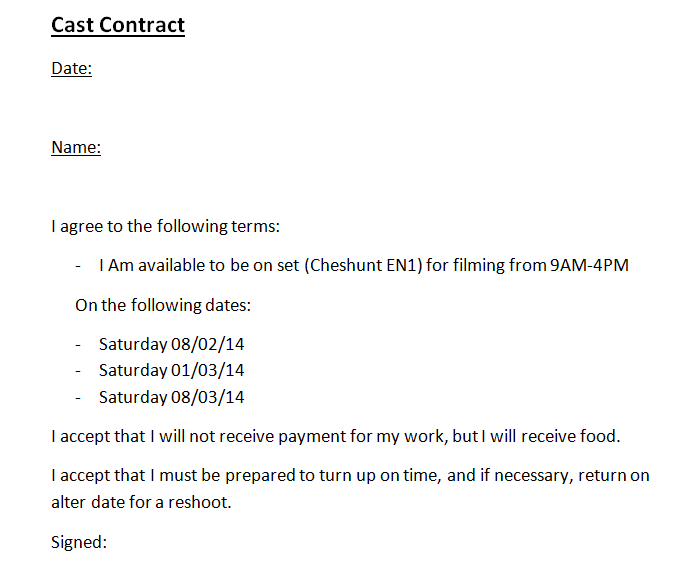
When filming we set out strict rules as to what time and when we had to be on set, confirming them in a contract:


This ensured we were all focused on task and that filming was efficient and professionally executed.

However, this also highlighted a personal learning curve for me, especially when filming using the GoPro, a new piece of technology to me. The device took me a while to get used to, and as i was solely in control of it, it was my job to ensure footage captured was good enough to use in the opening, i had to experiment many times with the angling and mounting of the device.

Post-Production

- After the prelim, we were more familiar with the software we use:

- For example, we had more experience with the Adobe Premiere pro application,  therefore our editing was of a  higher standard- we used new tools such as colour correction and Procamp to grade and increase the quality of our footage compared to the raw footage of our prelim.

-We were also able to apply more complex changes to our footage- slowing it down and speeding it, as well as cutting, cropping, and overlapping video, utilising the timeline to create a seamless narrative filled with film devices and effects.

- The biggest improvement was that we clearly managed to ensure stronger continuity and prevent jump-cuts or the breaking of the 180/30 degree rules, meaning that overall, in comparison our main task looks far more professional, believable and aesthetically pleasing.